EGH15CA Low-Assembly Linear Guide Block — 15 mm Square Type
The EGH15CA is the 15 mm low-assembly block of the EG series. It sits lower than the HG block of the same size and uses a two-point arc contact, so it absorbs mounting error on frames that were not hand-scraped. It runs on EGR rails and is not interchangeable with HGR.
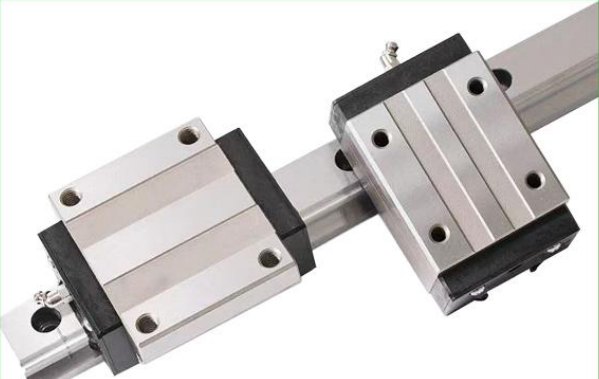
Specifications
| EGH20CA | 20 mm | Square, low assembly (C) | 10.31 |
| EGH25CA | 25 mm | Square, low assembly (C) | 16.27 |
| EGH30CA | 30 mm | Square, low assembly (C) | 23.7 |
Complete dimension table (mm) — EGH15CA
| H | 24 |
| H1 | 4.5 |
| N | 9.5 |
| W | 34 |
| B | 26 |
| B1 | 4 |
| C block length | 26 |
| L1 | 39.8 |
| L | 56.8 |
| Wr | 15 |
| Hr | 12.5 |
| D | 6 |
| h | 4.5 |
| d | 3.5 |
| P | 60 |
| E | 20 |
| Rail bolt | M3x16 |
| Dynamic C | 7.83 kN |
| Static C0 | 16.19 kN |
| MR | 0.13 kN-m |
| MP | 0.10 kN-m |
| MY | 0.10 kN-m |
| Block weight | 0.15 kg |
| Rail weight | 1.25 kg/m |
Transcribed from the current product catalogue. 2D drawing and STEP model on request.
Options
- Dust protection: standard wipers, or ZZ / KK / DD
- Grease nipple or oil port
- Special machining on request
Where this block is used
The square block carries load in all four directions and bolts down onto a machined face, so it suits the X, Y and Z axes of machining centres, grinders and gantry frames where the carriage is bolted from above. At this size the block is normally paired with one rail per axis; two rails are used when the table is wide enough that a single rail would let the carriage rock.
Mounting: rails and blocks are bolted to machined faces. Rail bolts are tightened from the centre outwards in the sequence given in the catalogue, and running accuracy is checked with a dial gauge before the carriage is loaded. Lubrication is by grease nipple or oil port; the re-greasing interval follows load and duty cycle, so it is agreed with the customer rather than fixed on the datasheet.
Matching rail
EGR15 rail is cut to order from 100 mm. See rail options.
Where this size is used
At 15 mm the guide is used on compact machine axes, router gantries and automation slides where the carriage stays under a few tens of kilos and the frame is already machined for an HG-standard block.
Mounting details for this size
All blocks in this family
The family shares one rail bolt pattern per size, so a machine designed around one block can move to another form without re-machining the rail. The table lists every model we publish in this family, with the size and the rated dynamic load.
| Model | Size | Type | C |
|---|---|---|---|
| EGH20CA | 20 mm | Square, low assembly (C) | 10.31 |
| EGH25CA | 25 mm | Square, low assembly (C) | 16.27 |
| EGH30CA | 30 mm | Square, low assembly (C) | 23.7 |
All models we publish, with sizes and load ratings, are on the linear guide blocks index; the rail side is on the rail index.
Check before you order
- Look up the 15 size on the replacement tool and confirm the dimensions against your drawing.
- Choosing between body types? See square or flange block.
- Fitting it, or unsure about preload? Read installation and lubrication.
Choosing this size
Three numbers decide whether this size is right: the load per block, the moment from an overhanging load, and the stroke. Work out the load first: if the carriage carries more than a third of the rated dynamic load C in normal operation, go one size up rather than increase preload. Preload does not raise the load rating; it only removes clearance, and over-preloading a light axis adds friction and heat for no gain.
For a horizontal axis with the load centred, ZA is usually enough. ZB is for a vertical axis, a cantilever, or a machine where the cutting force reverses direction; it is supplied as a matched set. Accuracy follows the machine, not the other way round: C for general automation, H for machine tools with a hand-scraped bed, P where the axis is measured against a straight edge. SP and UP are for grinding and measuring machines, and they come as a lapped block-and-rail set.
What to send with an enquiry
- Model and quantity, or the size if the model is still open.
- Accuracy grade and preload, or the application if you want us to recommend one.
- For rails: stroke, number of holes, or the centre distance between the end holes.
- Mounting orientation and the load on the carriage, if the axis is unusual.
- A drawing if you have one; if not, the four items above are enough to quote.
Quotations are made against the exact configuration, not a catalogue price. The reply states the model, the accuracy and preload, the rail length and the lead time for that combination, so the comparison with another supplier is on the same basis.
Downloads
STEP (AP214) model and 2D drawing for this size are available on request — ask us and we will email them.
FAQ
| Can an EG block run on an HGR rail? | No. The EG uses the EGR profile; the two are not interchangeable. |
| Is EG less accurate than HG? | Both run to P interchangeable and to UP as matched sets. The difference is rigidity, not the grade list. |
| Which preload should I order? | EG preload bands are lighter than HG: ZA is 0.03–0.05C here, against 0.05–0.07C on HG. Quote it with the series: ZA (EG, 0.03–0.05C). |